During the rebuild of this site on Astro, the navigation dropdown lost its frosted-glass blur. The open menu rendered as a flat translucent panel, and the hero headline behind it stayed perfectly readable — the exact opposite of what backdrop-filter: blur(36px) is supposed to do. There were no console errors, no failed requests, and the CSS in the repository was correct. The bug existed only in production builds. This post is the debugging path: the symptom, the plausible-but-wrong hypothesis, the actual root cause, and the general lesson about trusting build pipelines.
The symptom
The dropdown panels use a translucent dark background with a heavy blur, so page content behind the open menu dissolves into texture while the menu labels stay crisp. After the migration, the background was still translucent — but nothing behind it was blurred. The page text under the panel was as sharp as the text outside it.
The first thing worth noting is the dev/prod split: in the dev server the blur worked; in the built output it did not. Anything that behaves differently between dev and production is, by definition, a build-pipeline question — even when it looks like a CSS question.
The plausible wrong answer
The first hypothesis came straight from the CSS specifications. A transformed element, or an element with opacity below 1, forms a backdrop root — a boundary that confines backdrop-filter on descendants to content inside that ancestor. The panel wrapper carried transform and opacity for the open/close animation, which made this a credible mechanism: the blur was being scoped to the wrong subtree.
So the animation was restructured — transform and opacity moved off the blur-carrying element, the show/hide animation reduced to top and visibility. It is better CSS hygiene regardless. The blur did not come back.
That is the moment worth pausing on. A plausible mechanism that shares symptoms with the real bug is not a stepping stone to the answer; it is a detour that feels like progress. The hypothesis was not wrong as a risk — backdrop roots are real — but it was not the cause, and no amount of refinement to it would have fixed the site.
Reading what the build actually emitted
The next step was to stop theorizing about CSS and read the artifact the browser actually receives. The built stylesheet contained this:
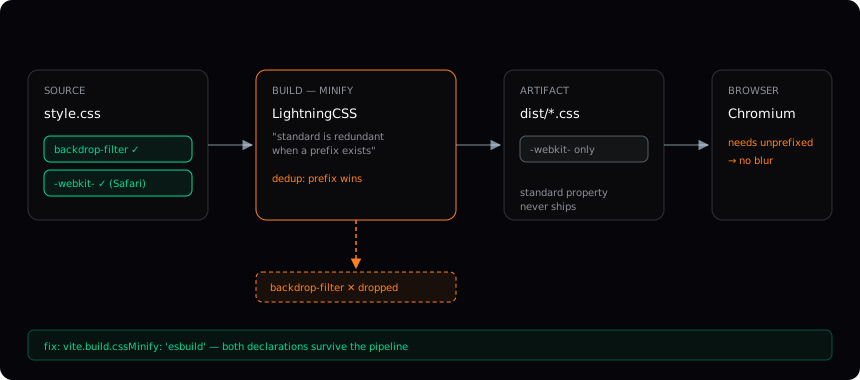
.nav-drop-panel>ul{-webkit-backdrop-filter:blur(36px);...}The unprefixed backdrop-filter was gone. The source file declared both forms — the standard property and the -webkit- prefix, the standard belt-and-suspenders pattern. The build had kept the prefix and silently discarded the standard property.
The root cause
The default CSS minifier in Vite 6+ (and therefore in Astro 7 builds) is LightningCSS. When it encounters a rule that declares both backdrop-filter and -webkit-backdrop-filter with the same value, it treats the standard property as redundant with the prefixed one and emits only the prefix. This is documented behavior, debated in the LightningCSS and Vite issue trackers — and it is the exact inverse of what Chromium needs. Current Chrome renders backdrop-filter; the prefixed alias alone did not produce a blur in testing. Safari is the opposite: it wants the prefix.
Which leads to the uncomfortable punchline: the widely recommended practice — declare both the prefixed and unprefixed forms — is precisely the input that triggers the minifier’s deduplication. The pattern designed to maximize compatibility was silently minimized into single-browser compatibility.
The fix
Two changes, one necessary and one hygienic:
- Switch the CSS minifier. Setting
vite.build.cssMinify: 'esbuild'preserves both declarations. esbuild’s CSS minifier does not perform this class of prefix-based deduplication. - Keep the blur-carrying element free of
transformandopacity. The backdrop-root hygiene from the wrong hypothesis is still correct: the element that carriesbackdrop-filtershould not have ancestors between it and the page content that form backdrop roots. The animation lives on the wrapper (top,visibility) and on the menu items (opacity), not on the blur surface.
Verification was mechanical: the built stylesheet must contain both declarations, and a headless-browser screenshot must show the hero text blurred to unreadability behind the open menu. Both pass. The fix is one line of configuration; finding it was the work.
The general lesson
Three practices carried this debugging, and they generalize past CSS.
Diff the artifacts, not the source. The source CSS was correct the whole time. The divergence was between what was written and what shipped. Any dev/prod behavioral difference should trigger an immediate comparison of build outputs — it is faster than any theory.
Build a minimal reproduction before forming a fix. A fifteen-line HTML page settled the browser question in one run: the prefixed-only form did not blur, the unprefixed form did. Without that page, the fix would have been a guess between “the minifier dropped something” and “the browser needs different markup.”
Treat the build pipeline as part of your runtime. The browser never saw the CSS that was written. Every transformation between the source and the network response — transpilation, minification, prefixing, tree-shaking — is code you ship without reviewing. When something breaks only in production, the pipeline is the first suspect, not the last.
The blur is back. The dropdown frosts properly. And the build configuration now carries a comment explaining exactly why the minifier is not the default — because the next person to “clean it up” deserves the whole story.